
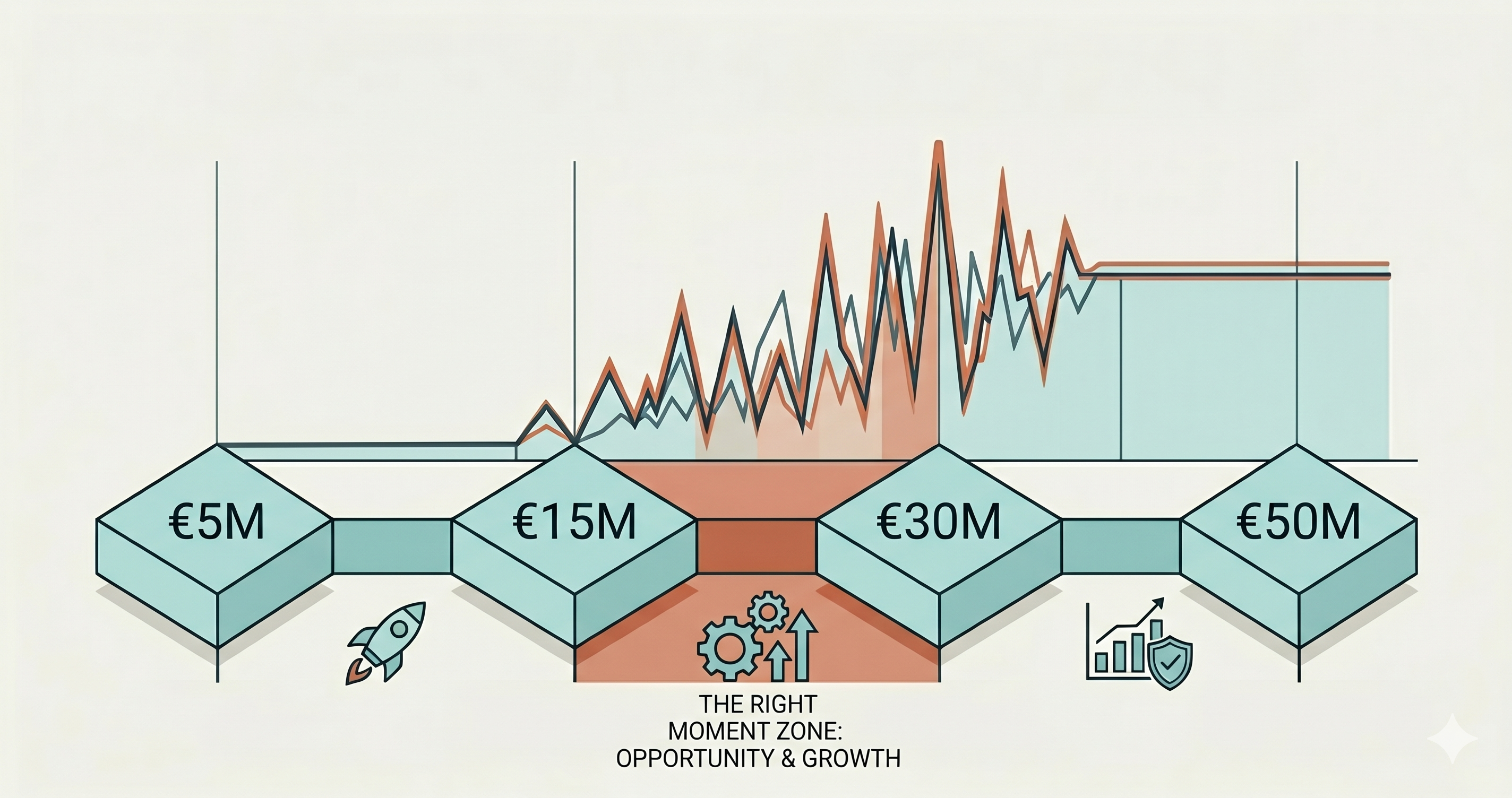
Not when things are calm. Not when you’re under €10M. Not when you “feel like the operation could be tighter.”
The honest trigger: you’re growing fast, your spreadsheets are breaking, your team is firefighting daily, and nobody owns the full picture end-to-end. If you’re hiring your first ops lead, picking an ERP, or scaling past €10M revenue without a system underneath, that’s the moment. Earlier is too early. Later is expensive.
This page is the decision framework. Not the sales pitch.
The four signals that say “now”
Most brands wait too long. They know something is off, but they hope it’ll resolve. It doesn’t. By the time they bring in help, the cracks are structural and the fix is harder.
1. Your forecast doesn’t match reality anymore
Six months ago, your forecast was within 10–15% of actual sales. Now it’s 30%, 40%, sometimes more. You’re stocked out on bestsellers and overstocked on slow movers. Marketing campaigns drive demand you can’t fulfill.
This isn’t a bad month. This is a structural sign that the system you built at an earlier scale doesn’t work at the current one. Channel mix shifted, SKU complexity grew, seasonality changed. The forecast didn’t keep up.
2. Your team is firefighting daily
Your ops lead spends 80% of their time chasing problems instead of preventing them. Stockouts, supplier delays, 3PL issues, customs, returns. Every day is a different fire. Strategic work doesn’t happen because there’s no time.
This isn’t a capacity problem. Hiring another ops person won’t fix it. It’s a structural problem: nobody owns the end-to-end view, so every fire gets handled in isolation while the underlying causes compound.
3. You’re about to make a major decision and you don’t have a framework
Picking an ERP. Choosing a 3PL. Hiring your first Head of Supply Chain. Each of these is a six-figure decision with a five-year impact, and most growing brands make them based on vendor pitches and gut feel.
The cost of getting one of these wrong isn’t the wasted money. It’s the 12–18 months of operational drag while you live with the wrong choice.
4. Cash is stuck in inventory
Your working capital position is getting worse, not better. More cash is locked up in stock than this time last year, but service levels haven’t improved. You’re paying suppliers faster than customers pay you.
This is the financial signal that Supply Chain has stopped scaling. Inventory is growing faster than revenue, and nobody can explain exactly why.
When NOT to hire a consultant
Equally important. Most consulting projects fail because the timing is wrong, not because the work is bad.
You’re under €10M
At this stage, Supply Chain isn’t your bottleneck. Growth is. A founder running Supply Chain in a spreadsheet is the right answer. Save the budget for marketing, product, and hiring.
You haven’t decided what good looks like
If you can’t articulate what you want your Supply Chain to deliver: service level targets, working capital limits, OTIF benchmarks. No consultant can help until that’s clear. Define the destination first. Then bring in help to get there.
You want a deliverable, not a system
If what you actually want is a deck or a strategy document, hire a traditional consultancy. If you want an operation that runs differently after the project ends, you need operators, not advisors. Implementation, not slides.
Your founder isn’t bought in
Supply Chain consulting touches every part of the business. If the founder isn’t actively involved, the project will stall the first time it requires a hard decision.
What good Supply Chain consulting actually looks like
Operators, not advisors. People who have actually run Supply Chains under growth. Ask for specifics about their last operational role, not the logos on their website.
Diagnostic before solution. Anyone who pitches you a solution before doing diagnostic work is selling, not consulting. The first two to four weeks should be mapping your operation.
Implementation, not just strategy. A roadmap is worthless if nobody owns the execution. Look for engagement models that include hands-on implementation phases.
Knowledge transfer built in. A good consultant should make themselves replaceable. The output is a system your team can run after they leave.
Transparent on price and scope. Fixed fees for diagnostic phases. Clear scope boundaries. No hidden change orders. If a consultant fails any of these tests, walk.
Which kind of help actually fits
PSCM House runs four kinds of engagement. Which one fits depends on where the gap sits, not on how big the brand is.
Bring in Interim when:
- You need real hands-on capacity now, not another recommendation, whether or not the leadership seat itself is open
- You’re mid-transformation (ERP switch, 3PL transition, rebuilding S&OP) and need someone actually doing the work
- The role, or the execution capacity behind it, needs covering right now, typically 3 to 6 months, without the six-month search and onboarding of a permanent hire
See the full breakdown of what an Interim Supply Chain Manager does and how the engagement runs.
Bring in Projects when:
- The problem has a defined start and end
- You need specific structural work done: ERP selection, S&OP setup, 3PL transition
- You want ownership from analysis through execution on one defined outcome, not an open-ended seat
Bring in Sparring when:
- You already have a Supply Chain leader, but no one senior to challenge their decisions before they’re made
- The problem is judgment and structure, not missing hands
- You need a second opinion on a specific call, not a project or a seat
Bring in Mentoring when:
- A junior or mid-level Supply Chain person is taking on more responsibility than they’ve had before
- The goal is developing that person, not fixing the operation directly
- No engagement with the founder or leadership team is needed
The mistake most brands make: hiring full-time too early. They burn through senior candidates who leave within 18 months because the role wasn’t ready. Diagnostic work first, often with Interim running the seat in the meantime, then permanent hire. Usually saves 12 months and a six-figure mistake.
What it costs
Interim runs at a fixed daily rate, billed monthly, sized to what the gap actually needs, typically 3 to 6 months. Projects, Sparring, and Mentoring are each scoped and priced to the engagement, not sold off a fixed rate card. Get in touch for current rates.
The real cost question isn’t the fee. It’s what happens if you don’t fix the operation: stockouts compounding, cash trapped in inventory, the wrong ERP picked, the wrong head hired.
How to decide
1. Can you articulate the gap? What is the operation delivering today, what should it deliver, and what’s missing? If you can’t answer in two minutes, the first job is diagnostic.
2. Do you have someone internal who can drive this? Consulting works when there’s an internal owner. Without one, the work doesn’t stick.
3. Are you willing to make decisions, not just receive recommendations? Good consulting forces decisions. If you want optionality and “more analysis,” you’ll burn budget without changing the operation.
If the answer to all three is yes, the timing is right.