
Most people think Supply Chain is logistics. It’s not.
Logistics moves boxes. Supply Chain decides which boxes exist in the first place: how many, where they sit, what they cost, and what happens when demand shifts. Logistics is one piece of Supply Chain. Treating them as the same thing is the first mistake most growing brands make.
This page is the honest version. Not the textbook definition. The version that matters if you’re running a D2C brand, scaling past €10M, and starting to feel things break.
The simple definition
Supply Chain is the end-to-end system that gets a product from raw material to your customer’s door, and back, if they return it. But that’s only half of it.
The other half is everything that holds the system together: the data you trust, the tools you run on, the cash tied up in stock, and the decisions nobody owns until something breaks.
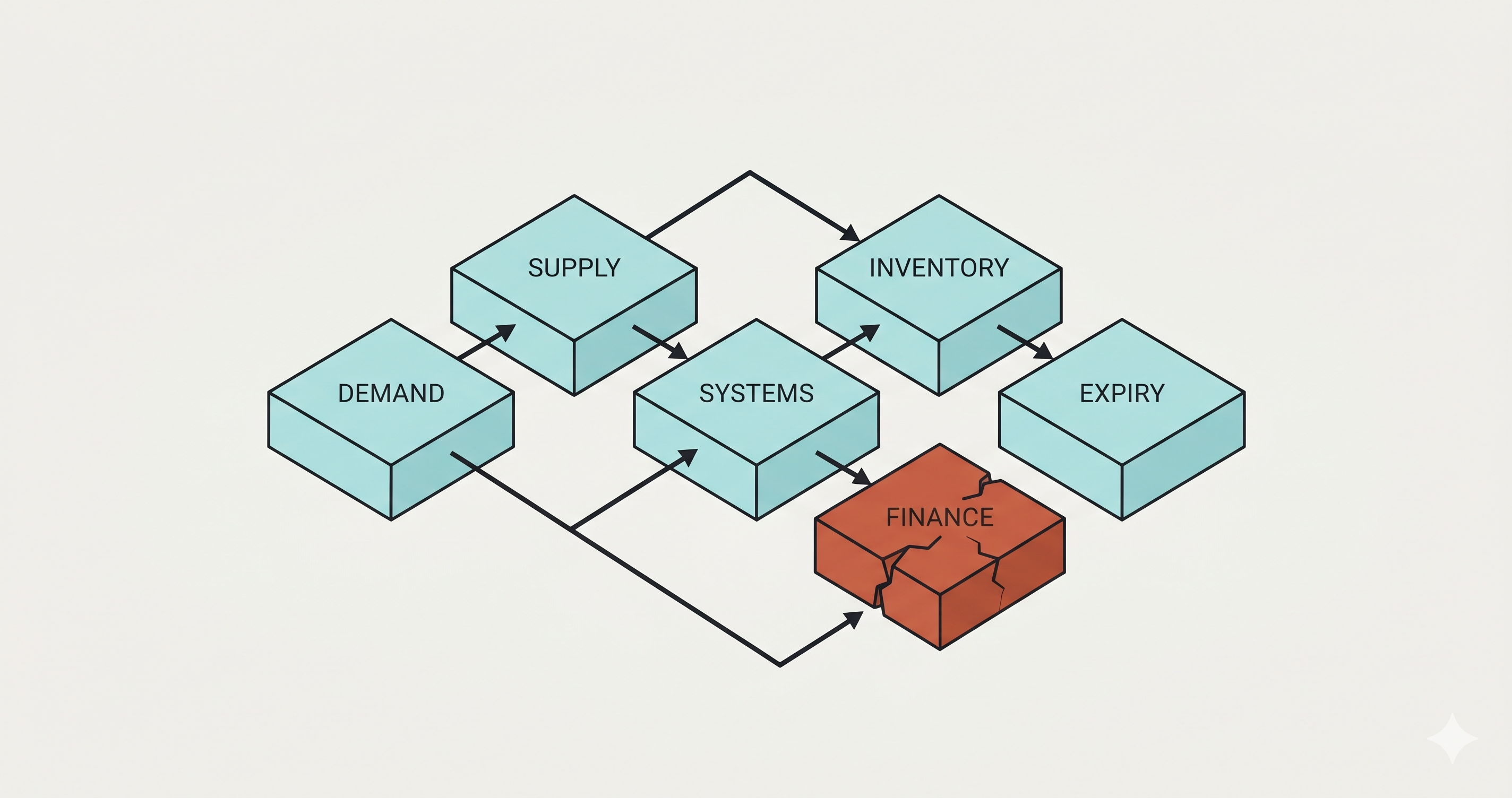
A real Supply Chain has six dimensions. Most brands focus on two or three and wonder why the others keep blowing up.
Why Supply Chain ≠ logistics
This distinction matters because it changes what you hire for, what you build, and where you invest.
Logistics is execution. Warehouses, carriers, last-mile delivery, customs. It’s operational, often outsourced to a 3PL, and it’s measured in cost-per-shipment and on-time delivery rates.
Supply Chain is decision-making. What product to launch. How much to order. Which supplier to trust. When to hold stock vs. when to drop-ship. How to react when a container is stuck in port. It’s strategic, lives across multiple departments, and it’s measured in service level, working capital, and gross margin.
If you only have a logistics person, you have someone who executes shipments well but can’t tell you why you’re overstocked on bestsellers and out of stock on hero SKUs. That’s a Supply Chain problem, not a logistics problem.
The six dimensions of a real Supply Chain
Most frameworks stop at the operational view: plan, source, make, deliver. That’s the textbook. The textbook doesn’t tell you why your Supply Chain breaks.
A working Supply Chain has six dimensions, and they all need to function together.
1. Demand
Forecasting how much you’ll sell, by SKU, by channel, by week. This is where most D2C brands fail first. They forecast in a spreadsheet that nobody trusts, then override it with gut feel, then wonder why inventory is wrong.
Good demand planning isn’t about predicting the future perfectly. It’s about being structured enough to learn from being wrong.
2. Supply
Sourcing, supplier management, procurement. Finding the right suppliers, negotiating terms, managing the relationship over time. The mistake most growing brands make: treating supply as a one-time event. You found a supplier, you placed an order, done.
In reality, supply is an ongoing relationship. Lead times shift. Quality drifts. Better suppliers appear. If nobody owns this, your costs creep up and your reliability drops without anyone noticing until it’s expensive.
3. Inventory
The single biggest lever for cash flow in any product business. Hold too little, you stock out and lose sales. Hold too much, your cash is locked up in a warehouse and your bestsellers expire while your dead stock sits.
The metrics that matter: stock cover, sell-through rate, dead stock percentage. If you’re not tracking these weekly, you’re flying blind.
4. Systems & Data
This is the dimension most operators ignore until it’s too late. Your forecast is only as good as the data feeding it. Your inventory numbers are only as accurate as the system tracking them. Your decisions are only as fast as the dashboard delivering them.
Most growing brands hit a point where the spreadsheet stops scaling, the data lives in five different tools, and nobody can answer a basic question without a one-hour Slack thread. That’s not a tooling problem. That’s a structural problem disguised as a tooling problem.
The right ERP doesn’t fix it. The right system architecture does.
5. Finance
Supply Chain decisions are financial decisions. Every euro in inventory is a euro not spent on growth. Every day of cash cycle is a day of working capital locked up. Every supplier payment term shifts your cash position.
Most operators don’t think this way. They optimize for service level or stock cover and let finance figure out the rest. The brands that scale think about Supply Chain and cash flow as one system, not two.
If your CFO and your Supply Chain lead don’t talk weekly, that’s a red flag.
6. Expiry & Lot (if it applies)
If you sell supplements, food, beverages, cosmetics, or anything with a shelf life, this is its own discipline. Lot tracking, expiry monitoring, FEFO logic, recall readiness, regulatory compliance.
Get it wrong and you’re either writing off expired stock at scale, shipping near-expiry product to customers, or sitting on a compliance risk that hasn’t surfaced yet. Brands without perishables can skip this. Brands with perishables can’t afford to treat it as an afterthought.
What changes when a brand grows
A €2M brand can run Supply Chain in a spreadsheet, with the founder making most decisions. It works because the volume is low and the chain is short.
A brand past €10M can’t. The volume is too high, the SKU count too complex, the channel mix too varied. What used to take 2 hours a week now takes 40, and the founder doesn’t have 40 hours.
The transition usually breaks in the same places:
- Forecasts stop matching reality. What worked at an earlier scale breaks at a higher one. Seasonality, channels, and SKU mix have all shifted.
- Inventory ballooned. Cash is stuck in stock. Bestsellers are out, slow-movers are overflowing.
- Systems can’t keep up. The spreadsheet that ran the business now breaks the business.
- Nobody owns the end-to-end view. Each function optimizes locally and the whole thing gets worse.
This is the moment Supply Chain stops being “logistics + a spreadsheet” and starts needing real structure.
What “good” looks like
One forecast everyone trusts. Not three different versions in three different tools. One number, updated regularly, used by sourcing, marketing, and finance.
Clear inventory targets per SKU. Minimum stock, reorder point, maximum stock. Defined, monitored, automated where possible.
One person who owns the end-to-end view. Not a logistics manager. Not an ops generalist. Someone whose job is the chain itself, making sure all six dimensions connect.
If you have those three things, you have a Supply Chain. If you don’t, you have departments pretending to be a system.
Why this matters for growth
Supply Chain is the boring answer to why some brands scale and others stall.
You can have the best product, the best brand, the best marketing, and still hit a wall at €10M because your Supply Chain can’t keep up. Stockouts kill momentum. Overstock kills cash. Quality issues kill reputation. None of it shows up in the marketing dashboard, but all of it shows up in the P&L.
The brands that scale past €20M, €50M, €100M aren’t the ones with the loudest brand. They’re the ones with the operational backbone underneath.
What to do next
If you’re under €10M, Supply Chain probably isn’t your bottleneck. Focus on growth. Run the spreadsheet. Don’t overbuild.
If you’re scaling past €10M, this is the inflection point. The cracks are starting to show. Now is when you decide: hire the role, build the system, or get help structuring it before it breaks.
If you’re past €30M and things are breaking, you already know. The question isn’t whether to fix it. It’s how fast.