
The honest answer: less than the headlines suggest, more than most operators realize.
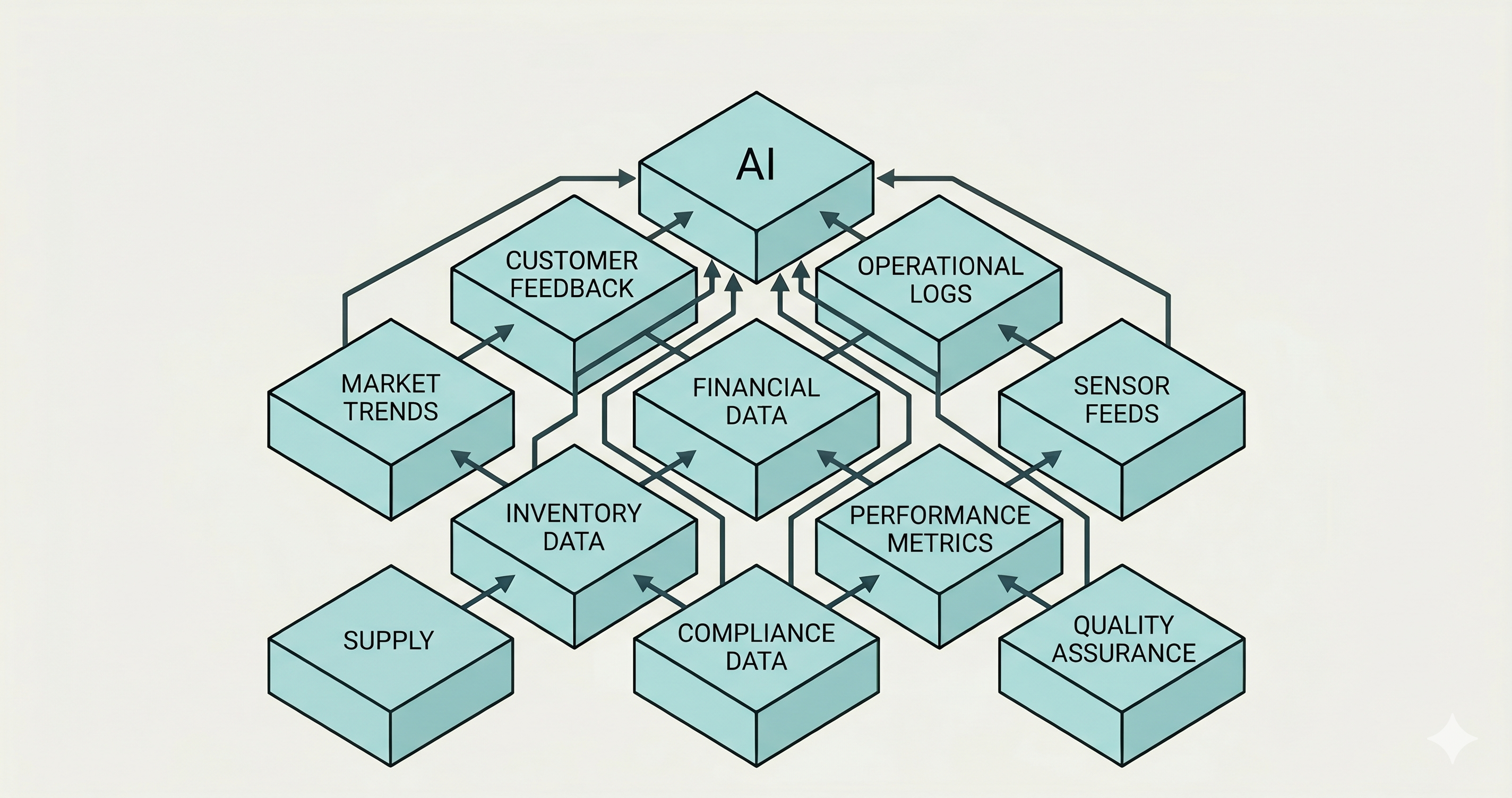
AI won’t replace your planner. It won’t fix a broken forecast. It won’t make a bad supplier reliable. But it’s already changing how forecasts get built, how purchase orders get triggered, and how exceptions get handled. The brands pulling ahead aren’t the ones buying the most tools. They’re the ones who fixed their data first, then layered AI on top.
Sequence matters. This page is the operator’s view, not the vendor pitch.
What AI actually does in Supply Chain today
Forget “AI-powered” as a marketing term. In practice, AI in Supply Chain means three things:
Pattern recognition at scale. Spotting demand signals, anomalies, and supplier risks faster than a human can in a spreadsheet. Where a planner sees one SKU at a time, AI sees 5,000 in parallel.
Prediction with feedback loops. Forecasting demand, lead times, and returns. Getting better at it the more data flows through. Static forecasts don’t learn. AI forecasts do, if the data is clean.
Decision automation for the boring stuff. Reorder triggers, exception alerts, replenishment recommendations. The work that used to eat 30% of a planner’s week now runs in the background.
That’s it. Anything beyond that, autonomous Supply Chains, fully self-driving logistics, is years away from being real for D2C brands. Don’t buy the pitch.
The three places AI is already useful
1. Demand forecasting
This is where AI delivers the most measurable value today. Traditional forecasting uses historical sales, seasonality, and gut feel. AI forecasting adds external signals: weather, search trends, marketing spend, channel-specific patterns, competitor pricing.
The result, when it works: 20–40% reduction in forecast error. Less stockout, less overstock, faster reaction to demand shifts.
The catch: it only works if your sales data is clean, attributed correctly across channels, and historically deep enough to learn from. Most growing brands fail this test. Their data is split across Shopify, Amazon Seller Central, retailer reports, and a 3PL system that doesn’t talk to any of them.
Fix the data foundation first. Then AI forecasting becomes useful. Skip that step and you’re paying a premium for a tool that produces the same wrong number, faster.
2. Replenishment & purchase order automation
The repetitive part of supply planning: calculating reorder points, generating purchase orders, flagging when stock is drifting toward minimum. This is exactly the kind of work AI handles well.
Modern systems can monitor every SKU continuously, factor in lead time variability, and trigger orders without human input for routine decisions. Planners then focus on exceptions: new product launches, supplier issues, seasonal anomalies.
Realistic gain: 50–70% reduction in time spent on routine PO management. That’s not transformation. That’s leverage. Same team, more output.
3. Anomaly detection
Things break in Supply Chain quietly. A supplier’s lead time creeps up by three days over six months. A carrier’s on-time rate drifts from 92% to 84%. A SKU’s return rate jumps from 8% to 14%. By the time anyone notices in a monthly review, the damage is done.
AI catches these patterns in real time. Not because it’s smart, but because it’s watching everything, all the time, without getting bored. For brands at scale, this is one of the most underrated use cases.
Where AI is not useful (yet)
Strategic decisions
Choosing a 3PL. Picking an ERP. Negotiating with a supplier. Deciding whether to hold safety stock for a launch. These are judgment calls. AI can inform them with data. It can’t make them.
Bad data environments
If your inventory numbers are wrong, AI will optimize against the wrong numbers. If your sales are misattributed across channels, AI will forecast the wrong demand. If your lead times aren’t tracked properly, AI will plan against fiction.
Garbage in, garbage out. Except now it’s automated, and the garbage scales.
Small SKU counts and short history
AI needs data to work. A brand with 30 SKUs and 18 months of sales history doesn’t have enough signal for meaningful pattern recognition. A spreadsheet plus a competent planner will outperform any AI tool at that scale.
The data problem nobody wants to talk about
Every AI conversation in Supply Chain skips the same step: the data isn’t ready.
Most growing D2C brands have:
- Sales data split across 3–5 channels with inconsistent SKU naming
- Inventory data in a 3PL system that updates daily, not real-time
- Lead times tracked in a Google Sheet that one person maintains
- Supplier performance recorded inconsistently or not at all
- Returns data living in a customer service tool, disconnected from inventory
The unsexy truth: 70% of “AI in Supply Chain” projects fail because of data, not because of the AI. Fix the foundation first.
What to do, depending on where you are
If you’re under €10M
Don’t buy AI tools. You don’t have the volume, the data depth, or the operational maturity to make them pay back. A planner, a clean spreadsheet, and weekly discipline will outperform any AI investment at this stage.
If you’re between €10M and €30M
This is the data foundation phase. Get your sales attributed correctly across channels. Get your inventory tracked accurately. Get your lead times measured consistently. Skip the AI tools until this is done.
If you’re between €30M and €80M
This is where AI starts paying back. Demand forecasting tools, replenishment automation, anomaly detection. All become real options. Pick one use case, prove it, then expand.
If you’re past €80M
The question shifts from “should we” to “where next, and how fast.” At this scale, the bottleneck is usually integration and change management, not the AI itself.
What to ignore
- “Autonomous Supply Chain”: marketing term. Real autonomy at scale is years away for D2C.
- “AI-powered ERP”: usually means a forecasting module bolted onto a standard ERP.
- “Generative AI for Supply Chain”: useful for documentation, supplier emails. Not a planning system.
- “AI agents that run your Supply Chain”: not real for operational decisions. Maybe in three to five years.
The vendor landscape is loud. Most of the noise is sales, not substance.
The honest summary
AI in Supply Chain is real, but it’s not magic. It’s leverage on top of a working operation.
If your operation isn’t working, if your data is broken, your forecast is gut feel, and your team is firefighting, AI won’t fix it. It’ll just make the fires move faster.
Fix the foundation. Get the data clean. Build the operational discipline. Then layer AI on top. The brands pulling ahead in 2026 aren’t the ones with the most AI. They’re the ones who got the boring stuff right first.